Meteorologists predict that the 2011 hurricane season will be more active than in previous years. Read this article.
Now's the time to send out a news release on the need for a home inventory -- if you live in a hurricane area.
Thursday, May 19, 2011


Friday, August 20, 2010
Reader Inquiry: Is it a Scam?
I received the following e-mail this week:
A business advertised on Craigslist for $495.00 for materials to start a home inventory business. They are based in FLorida and said they have more work than they can take on.
In addition to the initial fee, they are requiring $150.00 for every referral after the affiliate has been paid. their name is HTCA and when I looked the website up on whois.com
the website was registered in July of 2010. It seemed to good to be true. What do you think?
My response:
Most of these are a scam. Legitimate firms looking for subcontractors approach people directly ("competitors" in their area) or hire additional contractors or employees. If they legitimately have too much work, they're not going to be selling you a kit and then charging you $150 for referrals.
A business advertised on Craigslist for $495.00 for materials to start a home inventory business. They are based in FLorida and said they have more work than they can take on.
In addition to the initial fee, they are requiring $150.00 for every referral after the affiliate has been paid. their name is HTCA and when I looked the website up on whois.com
the website was registered in July of 2010. It seemed to good to be true. What do you think?
My response:
Most of these are a scam. Legitimate firms looking for subcontractors approach people directly ("competitors" in their area) or hire additional contractors or employees. If they legitimately have too much work, they're not going to be selling you a kit and then charging you $150 for referrals.
I addressed a similar issue in a previous blog post:
Sunday, May 31, 2009
Disasters Come In All Shapes
If you are targeting business owners with your inventory services, keep in mind that helping them with disaster planning can be an important part of the process. Just read about this Houston-area retailer whose business suffered a huge fire -- but his planning for hurricane preparedness helped minimize the downtime. Hope he had a business inventory besides his furniture inventory!
Saturday, November 15, 2008
Wildfires Threaten Los Angeles
Those in areas prone to wildfires may find this useful information in marketing their services. No one -- even Christopher Lloyd -- is immune to threats from Mother Nature.
About 2,600 acres were burned so far and gusts in the area exceed 75 mph. A map of the fire is at tinyurl.com/sayrefire.
Firefighters, two of whom have suffered minor injuries, are trying to stop the blaze before it reaches Santa Clarita, a bedroom community about 40 miles from the center of Los Angeles with a population of 180,000.
A second fire ravaged hills above Southern California's Santa Barbara coast for a second night after roaring through the exclusive Montecito enclave leveling 111 homes.
Those reported to have lost houses in the community dubbed "America's Riviera" included actor Christopher Lloyd, best known as the zany scientist in the "Back to the Future" movies.
About 2,600 acres were burned so far and gusts in the area exceed 75 mph. A map of the fire is at tinyurl.com/sayrefire.
Firefighters, two of whom have suffered minor injuries, are trying to stop the blaze before it reaches Santa Clarita, a bedroom community about 40 miles from the center of Los Angeles with a population of 180,000.
A second fire ravaged hills above Southern California's Santa Barbara coast for a second night after roaring through the exclusive Montecito enclave leveling 111 homes.
Those reported to have lost houses in the community dubbed "America's Riviera" included actor Christopher Lloyd, best known as the zany scientist in the "Back to the Future" movies.
Tuesday, September 23, 2008
New Tool for Inventorying DVD, Books, CDs
 There's a new tool you can use to quickly inventory client books, CDs, and DVDs. The tool, a handheld scanner, reads bar codes.
The Groqit scanner is portable, allowing users to take it with them while shopping to check titles against home inventory or create wishlists for friends to view. Scanned information can be uploaded to Groqit.com and translated into detailed listings that include titles, authors, and more.
Monday, September 22, 2008
An Example of Publicity After A Storm/Disaster
This news release by Total Logistics Solutions is a perfect example of a company building on the publicity generated by large natural disasters. This news release was posted on PR.com for distribution to news media around the world. It generated news coverage of their product, Cover Your Assets home inventory documentation system.
What have you done to get publicity?
What have you done to get publicity?
Tuesday, September 16, 2008
The Aftermath of Ike: The Need for Home Inventory Services
This is a news release I wrote -- this one is geared towards home inventory service professionals who live in areas outside of Texas (i.e., Louisiana, Florida, South Carolina, Georgia, etc.)
HURRICANE IKE VICTIMS MAY BE REVICTIMIZED BY INSURANCE COMPANIES
Hurricane Ike has come and gone, leaving billions of dollars of destruction in its wake. The state and federal government will pay to fix the damage to the infrastructure of Texas and Louisiana; small and large businesses will file insurance claims to cover their losses. That leaves the individual homeowners. They too will file their insurance claims -- the first step in a slow process of recovery. But while many businesses have "business interruption" coverage to help them cover costs in the meantime, individuals do not.
Insurance companies will dispatch their mobile disaster claim units to Texas, and the first thing the customer service representatives and agents will ask for is documentation of the loss.
For those that are quickly able to produce a comprehensive home inventory, processing the claim will begin almost immediately. For those without one, the process has just begun. They must begin to compile an inventory -- a difficult experience for shell-shocked survivors whose homes may have washed away or been reduced to a pile of rubble. Some may have to rely on their memories to reconstruct a record of their belongings. Others will have to slosh through their flood-ravaged homes to compile a record. In the absence of documentation or proof of ownership of the goods claimed, much of their claim may be denied.
"Your heart goes out to those who have already suffered the loss, and then must wait to start putting their lives back together because they can't prove what they've lost," says Bridget Brooks, editor of THISmagazine, a trade journal for home inventory service professionals. "For those who live in many hurricane-prone areas, it's not a matter of IF, but WHEN something will happen."
While many survivors of hurricanes will tell you "It's just stuff -- and stuff can be replaced," the hard reality is that many of them will receive an insurance settlement that is only a fraction of their loss, due to inadequate documentation.
For example, you may have just purchased a brand-new, 42" high-definition flat screen television for your living room. But if your home is swept out to sea in a hurricane, the insurance company may only pay to replace a "standard" television (at 1/3 to 1/2 the cost you paid) in the absence of proof of your purchase.
A comprehensive home inventory -- updated regularly -- is the only way to facilitate speedy, comprehensive payment of your claim. And while it's true that anyone can compile a home inventory, the harsh reality is that fewer than half of all homeowners actually have one.
A news release from the National Association of Insurance Commissioners (NAIC) reports that 48% of all consumers do not have any kind of an inventory. Further: "Of those consumers who reported having a checklist, 32 percent had not taken any pictures and 58 percent had no receipts validating the cost of their possessions. In addition, 44 percent of respondents acknowledged that they had not stored their inventory in a remote location," the survey found.
"When you live in a hurricane-prone area, not having a home inventory is just foolish," says Brooks. "We all hope that hurricanes don't hit, but if -- and when -- they do, you'd better be prepared. Prepare an emergency plan; prepare an evacuation plan; and most of all, prepare a home inventory -- or contact a professional who can compile one for you."
Brooks notes that the cost of a professionally-prepared home inventory ranges from $99 to $500, depending on the size of the home and the detail involved in the inventory (special collections and extensive belongings require more time to compile).
HURRICANE IKE VICTIMS MAY BE REVICTIMIZED BY INSURANCE COMPANIES
Hurricane Ike has come and gone, leaving billions of dollars of destruction in its wake. The state and federal government will pay to fix the damage to the infrastructure of Texas and Louisiana; small and large businesses will file insurance claims to cover their losses. That leaves the individual homeowners. They too will file their insurance claims -- the first step in a slow process of recovery. But while many businesses have "business interruption" coverage to help them cover costs in the meantime, individuals do not.
Insurance companies will dispatch their mobile disaster claim units to Texas, and the first thing the customer service representatives and agents will ask for is documentation of the loss.
For those that are quickly able to produce a comprehensive home inventory, processing the claim will begin almost immediately. For those without one, the process has just begun. They must begin to compile an inventory -- a difficult experience for shell-shocked survivors whose homes may have washed away or been reduced to a pile of rubble. Some may have to rely on their memories to reconstruct a record of their belongings. Others will have to slosh through their flood-ravaged homes to compile a record. In the absence of documentation or proof of ownership of the goods claimed, much of their claim may be denied.
"Your heart goes out to those who have already suffered the loss, and then must wait to start putting their lives back together because they can't prove what they've lost," says Bridget Brooks, editor of THISmagazine, a trade journal for home inventory service professionals. "For those who live in many hurricane-prone areas, it's not a matter of IF, but WHEN something will happen."
While many survivors of hurricanes will tell you "It's just stuff -- and stuff can be replaced," the hard reality is that many of them will receive an insurance settlement that is only a fraction of their loss, due to inadequate documentation.
For example, you may have just purchased a brand-new, 42" high-definition flat screen television for your living room. But if your home is swept out to sea in a hurricane, the insurance company may only pay to replace a "standard" television (at 1/3 to 1/2 the cost you paid) in the absence of proof of your purchase.
A comprehensive home inventory -- updated regularly -- is the only way to facilitate speedy, comprehensive payment of your claim. And while it's true that anyone can compile a home inventory, the harsh reality is that fewer than half of all homeowners actually have one.
A news release from the National Association of Insurance Commissioners (NAIC) reports that 48% of all consumers do not have any kind of an inventory. Further: "Of those consumers who reported having a checklist, 32 percent had not taken any pictures and 58 percent had no receipts validating the cost of their possessions. In addition, 44 percent of respondents acknowledged that they had not stored their inventory in a remote location," the survey found.
"When you live in a hurricane-prone area, not having a home inventory is just foolish," says Brooks. "We all hope that hurricanes don't hit, but if -- and when -- they do, you'd better be prepared. Prepare an emergency plan; prepare an evacuation plan; and most of all, prepare a home inventory -- or contact a professional who can compile one for you."
Brooks notes that the cost of a professionally-prepared home inventory ranges from $99 to $500, depending on the size of the home and the detail involved in the inventory (special collections and extensive belongings require more time to compile).
Monday, September 8, 2008
Market Potential for Home Inventory Service Businesses
What is the potential market for your home inventory service business? In theory, every homeowner, apartment renter, and business owner is a viable prospect.
A news release from the National Association of Insurance Commissioners (NAIC) outlines the number of individuals who do not currently have an inventory -- 48%, according to their survey.
"Of those consumers who reported having a checklist, 32 percent had not taken any pictures and 58 percent had no receipts validating the cost of their possessions. In addition, 44 percent of respondents acknowledged that they had not stored their inventory in a remote location," the survey found.
A news release from the National Association of Insurance Commissioners (NAIC) outlines the number of individuals who do not currently have an inventory -- 48%, according to their survey.
"Of those consumers who reported having a checklist, 32 percent had not taken any pictures and 58 percent had no receipts validating the cost of their possessions. In addition, 44 percent of respondents acknowledged that they had not stored their inventory in a remote location," the survey found.
The insurance industry supports the need for a home inventory. “A comprehensive list of your belongings and their value will help you file an insurance claim after a disaster,” said NAIC President and Kansas Insurance Commissioner Sandy Praeger. “Creating an inventory and storing it in a safe location away from home is one of the most basic — and most effective — disaster preparedness steps anyone can take to help protect themselves and their financial future.”
Sunday, September 7, 2008
An Idea for an Additional Service/Profit Center
I was reading the July issue of Inc. magazine and came across the story of ScanDigital, a company that scans and color-corrects photos. This sounds like an excellent add-on service for a home inventory service business -- and really, I see our industry going towards more full-service "disaster preparedness & recovery" in the next 3-5 years anyway. (I see this including not only inventorying property, but also marking it (i.e., DataDots); equipping households with disaster plans and emergency preparedness kits; consulting on securing valuables -- especially for quick evacuations, etc.)
You can read about a similar company in this article. It's not necessarily to offer "dirt cheap" pricing -- most of the prospects you're working with will be your existing customers, and this will be the first time they've heard of this service. As long as you're competitive with online rates (don't forget that your customers will save shipping and handling charges), you should be able to make some extra money off this service.
In the Inc. article, ScanDigital reports their average order is $330, and they get the majority of their customers via word of mouth. They als get residual revenue from customers, reporting that 15 to 20 percent of customers order mugs, additional prints, DVD slide shows, and calendars.
You can read about a similar company in this article. It's not necessarily to offer "dirt cheap" pricing -- most of the prospects you're working with will be your existing customers, and this will be the first time they've heard of this service. As long as you're competitive with online rates (don't forget that your customers will save shipping and handling charges), you should be able to make some extra money off this service.
In the Inc. article, ScanDigital reports their average order is $330, and they get the majority of their customers via word of mouth. They als get residual revenue from customers, reporting that 15 to 20 percent of customers order mugs, additional prints, DVD slide shows, and calendars.
Wednesday, August 27, 2008
TS Gustav Headed Towards New Orleans

A tropical storm is headed towards the Gulf of Mexico ... and may build into a hurricane before it reaches New Orleans. City leaders there are sounding the warning now ... and it's time for you to use this opportunity to get publicity for your home inventory service business.
My 16-page special report on "Getting Publicity for Your Home Inventory Service Business" includes a hurricane news release. You can purchase for $10 using the link below and the report will be delivered to you immediately. The special report also has information about how to build your media list, what to put in your media kit, ideas for what to write about in your news releases, sections you can target in your local newspaper, 12 timely news release topics, and 20 reasons to send a news release.
http://payloadz.com/go/sip?id
Monday, August 18, 2008
The Power of Public Speaking
One of the most effective ways to promote your home inventory service business is public speaking. I know, I know -- most people would rather do almost anything than get up in front of a group of people and talk, but the type of public speaking I'm talking about is fairly low-key.
What you're looking for is the opportunity to talk for 10-15 minutes about disaster preparedness -- and the ideal group is a homeowner's association's regular meeting. You'll create a basic handout with 5-10 tips for preparing for the types of disasters that are likely in YOUR area. (In Nebraska, where I'm located, that's tornadoes and flooding. In California, it would be earthquakes and wildfires. In Florida, it would be hurricanes.)
One of the tips, of course, is conducting a home inventory. I recommend giving away some information related to this -- for example, a checklist of items that should be included in their home inventory. Believe me -- even if a prospect has a list of what they should do (and these lists are widely available on the Internet), that doesn't mean they are going to do it.
In exchange for speaking to the group, negotiate for a free or reduced cost ad in the organization's newsletter. Hand out a coupon good for a %/$ off the cost of the inventory if they sign up within a specific period of time (30 days?).
How can you get the opportunity to speak to a group? Contact your local city government and see if they maintain a list of local homeowner's organizations.
What you're looking for is the opportunity to talk for 10-15 minutes about disaster preparedness -- and the ideal group is a homeowner's association's regular meeting. You'll create a basic handout with 5-10 tips for preparing for the types of disasters that are likely in YOUR area. (In Nebraska, where I'm located, that's tornadoes and flooding. In California, it would be earthquakes and wildfires. In Florida, it would be hurricanes.)
One of the tips, of course, is conducting a home inventory. I recommend giving away some information related to this -- for example, a checklist of items that should be included in their home inventory. Believe me -- even if a prospect has a list of what they should do (and these lists are widely available on the Internet), that doesn't mean they are going to do it.
In exchange for speaking to the group, negotiate for a free or reduced cost ad in the organization's newsletter. Hand out a coupon good for a %/$ off the cost of the inventory if they sign up within a specific period of time (30 days?).
How can you get the opportunity to speak to a group? Contact your local city government and see if they maintain a list of local homeowner's organizations.
Friday, June 27, 2008
"Disaster" Closer to Home
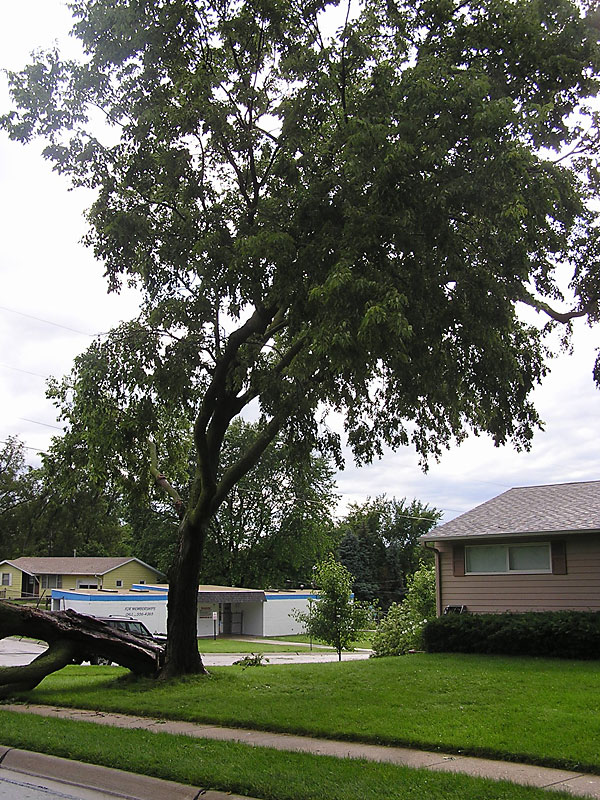 This is what's left of the tree in my front yard.
 The tree just split in two -- fortunately, it fell away from the house
(although it completely blocked the street).
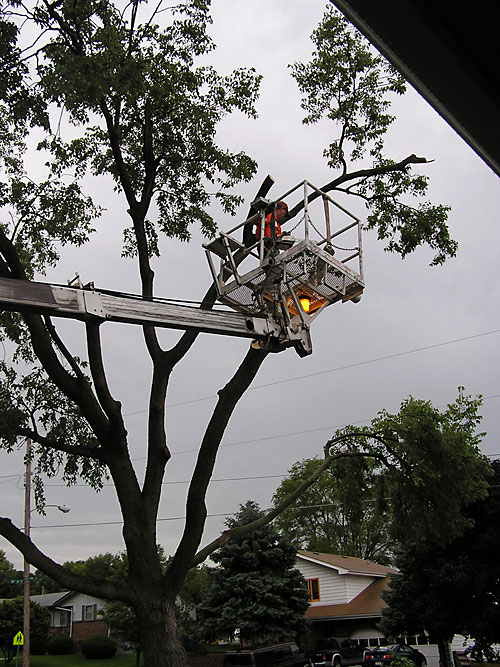 We've had more than a foot of rain over the last few weeks, weakening the hold the roots have on the ground. When 80-mile-an-hour winds came through, the tree just came out of the ground. This is the view of my backyard from my neighbor's driveway.
Just yesterday, I talked with my insurance agent after receiving my business insurance renewal policy. I wanted to make sure that my coverage was still adequate, since it had been a couple of years since I'd looked at it.
Good thing. A huge, fast-moving storm moved through today, packing 80- to 100-mile-per hour straight-line winds. We lost two of our mature trees in our yard (see photos), although it could have been much worse. Neither tree hit the house -- although the way the wind was blowing in (straight from the west), the one in the back yard should have crashed into the house. Instead, it fell to the south, taking out the fence, but sparing the house.
As I told my husband MANY times today ... it could have been a lot worse.
The damage wasn't significant enough to require a claim, but I've got my updated home inventory ready anyway. When disaster strikes close to home, make sure you're a good example for the public about being prepared.
Wednesday, June 25, 2008
More California Wildfires Threaten Homes
What a crazy year this has been! Unprecedented wildfires, tornadoes, and flooding. Only a couple of monster hurricanes would make this wild and crazy weather season complete.
The weather is big news right now -- and if you're not using it to get free publicity for your home inventory service business (especially to draw attention to the NEED for conducting a home inventory, whether you do-it-yourself or hire a professional), you're missing out on a great opportunity.
The weather is big news right now -- and if you're not using it to get free publicity for your home inventory service business (especially to draw attention to the NEED for conducting a home inventory, whether you do-it-yourself or hire a professional), you're missing out on a great opportunity.
Sunday, June 15, 2008
The $99 Sweet Spot
I know a lot of people get into the home inventory business with the promise of GETTING RICH QUICK!!! but the reality is, it takes time to build this business. The general public is pretty much unaware of the availability of providers who offer this service -- and, until they have a claim, they don't understand the need.
So I'm going to buck the conventional wisdom and encourage new (and existing) service providers to see their business development efforts as a longer term strategy.
I live in Omaha, Nebraska -- the home of the college baseball national championships -- the College World Series -- and I'm going to explain this strategy with a baseball analogy.
Instead of trying to hit a "HOME RUN" -- that is, a $400-$500 inventory order -- try hitting a series of "base hits." Your first goal would be to get prospects to allow you to come out and offer a free evaluation of their needs. That will allow you to see what they've got to inventory (home, garage, shed?) and show them your sample inventory book.
Your second goal should get them to buy SOMETHING. That might be an Express Inventory (a concept I outlined in my earlier post on jumpstarting your home inventory service business), or an entry-level package (under $150).
Your third goal should be to sell them an ADDITIONAL service, such as a DVD add-on to their Express Inventory, or maybe some Data Dots labeling, or a home disaster kit or first-aid kit or a home fire extinguisher.
Your fourth goal should be to recontact them after six months and do either an Update Inventory or expand their initial inventory to include further detail (maybe getting them to spend an additional $100 to do a detailed inventory of their garage or basement this time around).
Your fifth goal (and this can come anywhere along the first four steps) should be to get them to refer 2-3 other folks who might be interested in your services -- that could be neighbors, friends, or relatives.
This is a business that will build over time. Build positive momentum by getting some sales (even small ones) under your belt right away ... and then build up to larger ones. It's a strategy for success ... and the sweet spot is easier to achieve than trying to ring up a $500 sale right off the bat.
So I'm going to buck the conventional wisdom and encourage new (and existing) service providers to see their business development efforts as a longer term strategy.
I live in Omaha, Nebraska -- the home of the college baseball national championships -- the College World Series -- and I'm going to explain this strategy with a baseball analogy.
Instead of trying to hit a "HOME RUN" -- that is, a $400-$500 inventory order -- try hitting a series of "base hits." Your first goal would be to get prospects to allow you to come out and offer a free evaluation of their needs. That will allow you to see what they've got to inventory (home, garage, shed?) and show them your sample inventory book.
Your second goal should get them to buy SOMETHING. That might be an Express Inventory (a concept I outlined in my earlier post on jumpstarting your home inventory service business), or an entry-level package (under $150).
Your third goal should be to sell them an ADDITIONAL service, such as a DVD add-on to their Express Inventory, or maybe some Data Dots labeling, or a home disaster kit or first-aid kit or a home fire extinguisher.
Your fourth goal should be to recontact them after six months and do either an Update Inventory or expand their initial inventory to include further detail (maybe getting them to spend an additional $100 to do a detailed inventory of their garage or basement this time around).
Your fifth goal (and this can come anywhere along the first four steps) should be to get them to refer 2-3 other folks who might be interested in your services -- that could be neighbors, friends, or relatives.
This is a business that will build over time. Build positive momentum by getting some sales (even small ones) under your belt right away ... and then build up to larger ones. It's a strategy for success ... and the sweet spot is easier to achieve than trying to ring up a $500 sale right off the bat.
Thursday, June 5, 2008
Spring Severe Weather a Marketing Opportunity

The recent above-average outbreak of severe storms and tornadoes has provided a marketing opportunity for home inventory service business owners in the Midwest. Photos of devastation and families sifting through their lost belongings are potent reminders for prospective clients about the need for home inventory services.
If you are a home inventory service provider in an area that has been hit by tornadoes -- or is traditionally a tornado-prone area, use this opportunity to generate media coverage of your services. Send out a news release or call your local television station and offer to show how homeowners should conduct a comprehensive home inventory. Now's the perfect time.
My 16-page special report on "Getting Publicity for Your Home Inventory Service Business" includes several sample news releases, including one appropriate for adapting to promote your services in a tornado-prone area. You can purchase for $10 using the link below and the report will be delivered to you immediately. The special report also has information about how to build your media list, what to put in your media kit, ideas for what to write about in your news releases, sections you can target in your local newspaper, 12 timely news release topics, and 20 reasons to send a news release.
http://payloadz.com/go/sip?id
Friday, May 23, 2008
Wildfires Continue to Burn in California

About 1,400 homes remained under evacuation orders — more than 300 of them mandatory — while more than 900 firefighters and a swarm of tanker planes and helicopters continued dousing the area, near Gilroy, Calif.
Officials said that of the 12 structures destroyed, at least two were homes. Three schools in the area closed because of the fire, officials said.
Ian McClelland, 50, who has lived there since 1987 on his 23-acre ranch, woke up Thursday morning to an orange glow on the hillside. After returning to his property later, nothing was left except the concrete foundations.
Thursday, May 22, 2008
Analysts Expect Busy Atlantic Hurricane Season
Already it's been an above-average year for tornadoes in the U.S., and the Atlantic hurricane season is expected to be just as busy, according to analysts. This year, there is a 65 percent chance of an Atlantic hurricane season with more storms than normal, officials with the federal government's Climate Prediction Center warned today.
The Climate Prediction Center outlook calls for considerable activity with a 65 percent probability of an above normal season and a 25 percent probability of a near normal season. This means there is a 90 percent chance of a near or above normal season.
The Climate Prediction Center outlook calls for considerable activity with a 65 percent probability of an above normal season and a 25 percent probability of a near normal season. This means there is a 90 percent chance of a near or above normal season.
For 2008, the outlook indicates a 60 to 70 percent chance of 12 to 16 named storms.
Tuesday, May 13, 2008
Wildfires in Florida

This has been an active season for natural disasters that remind prospective customers about the need to inventory their homes! The latest calamity is a series of wildfires that has destroyed nearly 70 homes in Florida.
Friday, May 9, 2008
Find Crime Stats for Your Area
One of the most compelling cases you can make for prospects -- whether they are homeowners or business owners -- is to bring the threats "home" to them. Make the potential threats they face real to them, by identifying statistics for your area.
In a Google search, I found HelloOmaha.com, which includes crime statistics for Omaha (where I live). Look on the site and see if your city statistics are offered -- click on the blue "Visit Other Cities" link at the top of the page.
By finding the site, I found that Omaha had (in 2006):
In a Google search, I found HelloOmaha.com, which includes crime statistics for Omaha (where I live). Look on the site and see if your city statistics are offered -- click on the blue "Visit Other Cities" link at the top of the page.
By finding the site, I found that Omaha had (in 2006):
- 304 robbery reports
- 10,499 property crimes
- 1,469 burglaries
- 7,477 thefts
Saturday, May 3, 2008
Jumpstart Your Home Inventory Service Business
One of the problems I've had with the current marketing of home inventory service businesses is that the emphasis of the sellers of "business start-up systems" on getting people to purchase a "Cadillac" of inventories right off the bat.
I understand their reasoning -- it's hard to get people to invest in a $300-$500 "startup kit" with the prospect of making $500 a month. But that's also the REALITY of the situation that most home inventory service business owners face.
The home inventory service business is in its infancy at this point. Few people have heard of the service ... even fewer nationally have actually used a home inventory service business to document their possessions. Of course, once they do decide to use the service -- and particularly if they ever need to file a claim -- they're sold. But understandably, few people want to be pioneers.
So when you come around and offer to document all their possessions for $300-$500, you face some hurdles:
Jumpstart your business sales by offering an "Express" Inventory for $99 (or $149 with a DVD video). Offer 60-90 minutes of services focusing on overall documentation (photos by the room) as well as documentation (1-2 photos plus serial number and purchase price recording) of up to 20 items (big ticket items -- TVs, computers, iPods, stereo equipment, etc.). Offer to document additional items as an additional cost (say, 1o more items for $25 or 25 more items for $50).
This will help you start generating revenue while building your client list. You can do up to 2 of these express inventories in one evening (one from 5:30 to 7 and the other from 7:30 to 9 p.m.). Do 5-6 express inventories in a week, and you'll earn an extra $2,000 a month. Plus, you'll build a portfolio of inventories, an opportunity to convert them into full inventory package orders later (offer a $25 gift certificate towards an upgrade to a "full" inventory package), and you'll have a list of clients you can contact in 6 months or a year to do an "update" inventory. Plus, you can generate referrals from these customers.
See if you can get the initial customer to refer someone right off the bat. You might offer the service for $79 if they refer someone who books an appointment with you for an Express Inventory and becomes a customer. Offer a $20 discount off for each referral -- if they refer five customers, they get their inventory for free!
In your first couple of months of business, you might end up doing a dozen or more of these "loss leader" inventories -- but you'll be building your business. And I've always felt that the home inventory service business should be one where you don't just serve the client ONCE -- you work with them once or twice a year. Do the initial express inventory and then contact them for a six-month update with an additional 10-20 items for a $59 fee.
If you do 20 inventories in a month, you'll have done more than 200 by year's end ... and the likelihood of one of those individuals needing to file a claim during the year is quite high (11% of homes file an insurance claim each year, on average). That will allow you to get testimonials from satisfied customers who were able to use their inventory, and will help connect you to insurance agents who are in the position to refer more clients.
You'll earn more revenue from a series of "base hits" ($100/express inventory) than trying to hit a home run ($300/full inventory).
I understand their reasoning -- it's hard to get people to invest in a $300-$500 "startup kit" with the prospect of making $500 a month. But that's also the REALITY of the situation that most home inventory service business owners face.
The home inventory service business is in its infancy at this point. Few people have heard of the service ... even fewer nationally have actually used a home inventory service business to document their possessions. Of course, once they do decide to use the service -- and particularly if they ever need to file a claim -- they're sold. But understandably, few people want to be pioneers.
So when you come around and offer to document all their possessions for $300-$500, you face some hurdles:
- They've never heard of someone offering this service before, so you need to educate them.
- They don't know you, and they're trusting you to come into their home. (How do they know you're not going to use that information for nefarious purposes?)
- A minimum investment of $300 is quite a bit of "insurance" to purchase when they don't know if they'll have a claim or not.
- They think that their existing insurance will cover their losses (it often isn't until they have a claim that they realize the burden of proof that is required from them).
Jumpstart your business sales by offering an "Express" Inventory for $99 (or $149 with a DVD video). Offer 60-90 minutes of services focusing on overall documentation (photos by the room) as well as documentation (1-2 photos plus serial number and purchase price recording) of up to 20 items (big ticket items -- TVs, computers, iPods, stereo equipment, etc.). Offer to document additional items as an additional cost (say, 1o more items for $25 or 25 more items for $50).
This will help you start generating revenue while building your client list. You can do up to 2 of these express inventories in one evening (one from 5:30 to 7 and the other from 7:30 to 9 p.m.). Do 5-6 express inventories in a week, and you'll earn an extra $2,000 a month. Plus, you'll build a portfolio of inventories, an opportunity to convert them into full inventory package orders later (offer a $25 gift certificate towards an upgrade to a "full" inventory package), and you'll have a list of clients you can contact in 6 months or a year to do an "update" inventory. Plus, you can generate referrals from these customers.
See if you can get the initial customer to refer someone right off the bat. You might offer the service for $79 if they refer someone who books an appointment with you for an Express Inventory and becomes a customer. Offer a $20 discount off for each referral -- if they refer five customers, they get their inventory for free!
In your first couple of months of business, you might end up doing a dozen or more of these "loss leader" inventories -- but you'll be building your business. And I've always felt that the home inventory service business should be one where you don't just serve the client ONCE -- you work with them once or twice a year. Do the initial express inventory and then contact them for a six-month update with an additional 10-20 items for a $59 fee.
If you do 20 inventories in a month, you'll have done more than 200 by year's end ... and the likelihood of one of those individuals needing to file a claim during the year is quite high (11% of homes file an insurance claim each year, on average). That will allow you to get testimonials from satisfied customers who were able to use their inventory, and will help connect you to insurance agents who are in the position to refer more clients.
You'll earn more revenue from a series of "base hits" ($100/express inventory) than trying to hit a home run ($300/full inventory).
Subscribe to:
Posts (Atom)


